
The complete guide
The Practical Buyer's Guide to H4 LED Headlight Bulbs
The problem this set solves
You are standing at the front of your truck with a flashlight, looking at headlights that throw a tired yellow glow. Maybe it is a trail rig. Maybe it is a project car that only ever sees a show field or your own driveway. Either way, the light looks dated next to everything parked around it, and you want a cleaner, whiter look without rewiring anything.
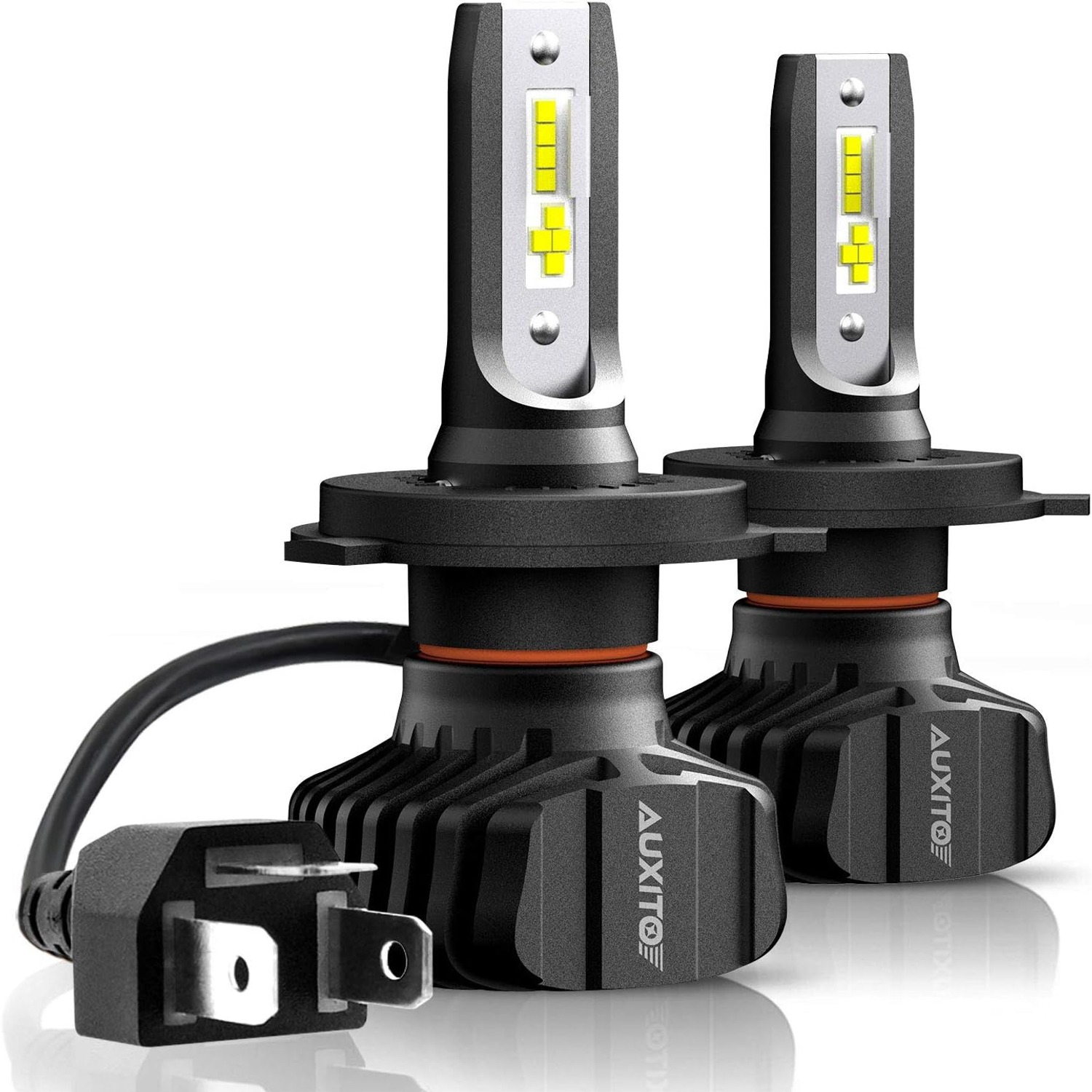
That is where an H4 LED conversion kit comes in. The H4 base is one of the most common headlight bases out there, and this set uses it. Two bulbs, one color temperature, no fan inside. The idea is simple: pull the old bulbs, put these in, and change the look of the front end.
Before anything else, there is one thing worth saying plainly, and we would rather say it at the top than bury it. This is an LED conversion bulb. In the United States, fitting LED bulbs into headlights that were built for halogen bulbs is generally not permitted on public roads. This set is sold for off-road, show and private property use. If you are shopping for a daily driver that lives on public roads, this is not the product for that job.
What H4 actually means
It describes the physical shape of the bulb's base and the connector it plugs into. You will also see the same fitting sold as 9003 or HB2, which trips people up constantly. Those are different names for the same thing.
The quickest way to confirm what you have is to look. Open the hood, find the back of the headlight housing, pop the dust cap, and twist the bulb free. Most bulbs have the type printed on the base or on the glass. If it says H4, 9003 or HB2, this set has the matching base.
If the marking has worn off, your owner's manual usually lists the bulb type in the maintenance section. Failing that, a photo of the old bulb sent to us is often enough for us to tell you what you are looking at.
How an LED conversion bulb works
A halogen bulb makes light by running current through a filament until it glows. An LED bulb makes light from semiconductor chips instead. The chips sit on a mount shaped to roughly match where the halogen filament used to be, and the base is built to fit the same socket.
Because the chips produce heat in a small area, every LED bulb needs some way to move that heat away. Some use a small fan tucked into the base. This set is fanless, which means it uses a passive heat sink instead. No fan, no faint whirring sound, and one fewer moving part to think about.
The trade-off is physical. A heat sink needs room and it needs air moving around it. If your headlight housing is buried behind a battery, a strut tower or a tight liner panel, measure your clearance before ordering any fanless led headlight bulbs. A tape measure and five minutes now beats a return later.
Color temperature, explained without the jargon
The listed color temperature here is 6500K. Kelvin is a scale that describes the tint of light. Low numbers look warm and yellow, the way a standard halogen bulb does. High numbers look cool and white.
At 6500K you are at the cool white end. That is the tone most people picture when they imagine a modern headlight. Next to a halogen bulb the difference is obvious, and that visual change is the main reason people pick 6500k led headlight bulbs for a build.
One thing worth being clear about: Kelvin does not tell you how much light a bulb makes. It only describes the color. We do not publish output figures for this set, so if someone quotes you a number for it, treat that with caution.
Who this suits
This set makes sense for a few kinds of buyers.
If you run an off-road vehicle that spends its life on trails, private land or a worksite, the public road restriction is not an issue for you, and a white led headlight bulb changes the look of the rig considerably.
If you are building a show car or a display vehicle, the same applies. Appearance matters more than anything else, and the vehicle is trailered or driven only on private property.
If you want a quiet install with no fan noise, the fanless design here is the point. Some people simply do not want a tiny fan running inside a sealed housing where they cannot reach it.
And if you are after something for a car that lives on public roads, this is not it. We would rather tell you that up front.
Choosing well: the checklist
Start with the base. Confirm your headlight takes H4, 9003 or HB2. Everything else is wasted effort if the base does not match.
Then measure your rear clearance. Pop the dust cap and check how much room sits behind the socket. Fanless designs need space and airflow, and tight engine bays are where most installs go wrong.
Next, think about the electrical side. Some vehicles monitor their lighting circuits and will show a bulb warning, or produce flicker, when an LED bulb replaces a halogen one. It is not universal, but it is common enough that you should know about it before you order. The usual fix is a CANbus decoder, and a decoder is not included with this set. If your vehicle is known to need one, budget for it separately.
Finally, buy the pair. You get two bulbs here for exactly that reason. Running one LED and one halogen across the front looks mismatched, and you will see it every time you walk up to the vehicle.
Installing without drama
Disconnect the battery first. Any time you are working on a lighting circuit, that is the sensible starting move.
Let the old bulbs cool if the vehicle has been running. Halogen bulbs get genuinely hot and will burn you.
Handle the new bulbs by the base or the heat sink. Keep your fingers off the LED chips and the light-emitting surfaces. Clean gloves make this easy.
Seat the bulb properly, reconnect the plug, and put the dust cap back on before you test. The cap is part of keeping moisture out of the housing, so do not leave it off, and do not leave it loose.
Test both sides before you put tools away. If you see a bulb warning on the dash or notice flicker, that is the circuit behavior mentioned earlier rather than a dead bulb, and a decoder is the usual answer.
Keeping them in good shape
LED bulbs do not need much maintenance, but heat is the thing to watch. Dust that builds up on a heat sink slows heat transfer, so wipe it with a dry cloth when you have the housing open for anything else.
Avoid solvents near the bulb. Keep the housing sealed. If you ever notice water inside the headlight, sort the seal out before worrying about the bulb, because moisture is bad news for any led headlight upgrade.
Beyond that, leave them alone. There is no filament to shake loose and no fan bearing to wear out in a fanless design.
What we will not claim
The confirmed specs for this set are the H4 fitting, an LED light source, two bulbs per pack, a 6500K color temperature and fanless cooling.
We do not publish brightness comparisons, lifespan hours or performance claims for this product, because we do not have verified figures for it. If you need a number we do not have, ask and we will tell you honestly that we do not have it.
The short version
This is a two-bulb set of H4 LED headlight bulbs with a 6500K cool white color and a fanless build. The H4 base is also sold as 9003 and HB2, so check your old bulb for any of those markings.
Measure your clearance behind the housing before ordering, since a fanless design relies on a heat sink. Know that some vehicles will show a bulb warning or flicker and may need a CANbus decoder, which is not included here.
And the part that matters most: this is an LED conversion bulb sold for off-road, show and private property use. In the United States, fitting LED bulbs into headlights built for halogen bulbs is generally not permitted on public roads. Buy it for the rig, the trail truck or the show car, and you will know exactly what you are getting.